Human Rights Council Concludes its 61st Regular Session with the Appointment of 17 New Mandate Holders
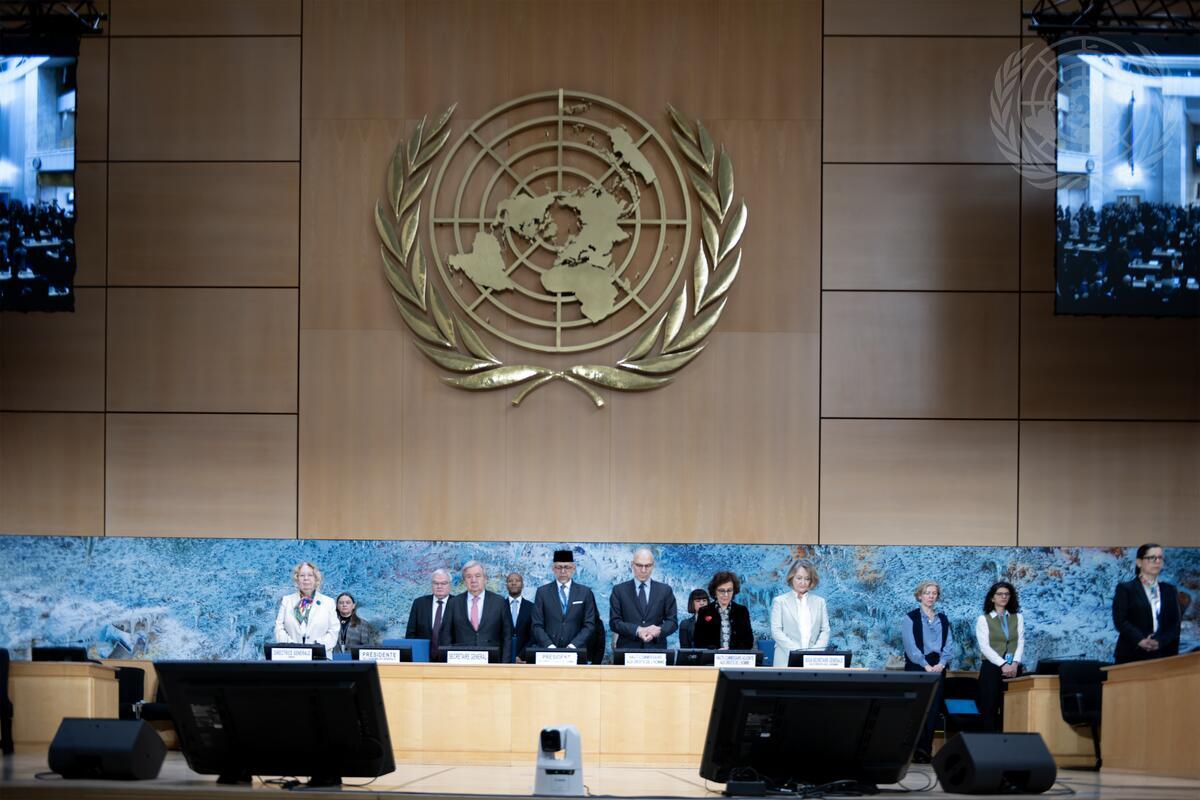
(61st session of the Human Rights Council: a moment of silence for victims of human rights violations around the world) UN Photo/Violaine Martin View More
On March 31, 2026, the United Nations Human Rights Council concluded its 61st regular session. Some important topics of discussion during the session included the current conflict in the Middle East, human rights of the unhoused, and cost-saving measures (in view of the current liquidity crisis at the UN). A total of 38 resolutions were adopted during the session.
The Council also voted to extend the mandate of a number of its special procedures and investigative bodies. The following 9 thematic mandates were extended for three years:
- Independent Expert on the effects of foreign debt and other related international financial obligations of States
- Special Rapporteur on the promotion and protection of the right to freedom of opinion and expression
- Special Rapporteur on adequate housing
- Special Rapporteur on the situation of human rights defenders
- Special Rapporteur on the human rights of migrants
- Special Rapporteur on minority issues
- Special Rapporteur on contemporary forms of racism, racial discrimination, xenophobia and related intolerance
- Special Rapporteur on the sale, sexual exploitation and sexual abuse of children
- Special Rapporteur on torture and other cruel, inhuman or degrading treatment or punishment
The following 4 country-specific special procedures were extended for one year:
- Special Rapporteur on the situation of human rights in Belarus
- Special Rapporteur on the situation of human rights in the Democratic People’s Republic of Korea
- Special Rapporteur on the situation of human rights in Myanmar
- Independent Expert on the situation of human rights in Mali
The following investigative bodies were also extended for one year:
- Group of Independent Experts on the Situation of Human Rights in Belarus (GIE-Belarus)
- Commission on Human Rights in South Sudan (CoHR-South Sudan)
- International Commission of Inquiry on the Syrian Arab Republic (COI-Syria)
- Independent International Commission of Inquiry on Ukraine (COI-Ukraine)
Though not technically special procedures, the mandate of the the Intergovernmental Working Group on the Effective Implementation of the Durban Declaration and Programme of Action, as well as that of the independent human rights expert appointed by the High Commissioner for Human Rights and tasked with undertaking the monitoring of the human rights situation in Haiti, were extended as well.
17 new individuals were appointed to special procedure and expert mechanism mandates under the auspices of the Human Rights Council:
- Thomas Andrews (United States of America) will now serve as Special Rapporteur on the situation of human rights in Cambodia;
- Ramona Biholar (Romania) will now serve as Eastern Europe region member of the Expert Mechanism on the Right to Development;
- John Phillip Binondo (Philippines) will now serve as Asia-Pacific region member of the Working Group of Experts on People of African Descent;
- Andrea Bolaños Vargas (Colombia) will now serve as Special Rapporteur on the situation of human rights defenders;
- Koldo Andoni Casla Salazar (United Kingdom of Great Britain and Northern Ireland) will now serve as Special Rapporteur on adequate housing;
- Elena Carolina Diaz Galan (Spain) will now serve as Special Rapporteur on extreme poverty and human rights;
- Zeina Jallad (State of Palestine) will now serve as Special Rapporteur on the negative impact of unilateral coercive measures on the enjoyment of human rights;
- Serges Alain Djoyou Kamga (South Africa) will now serve as Africa region member of the Expert Mechanism on the Right to Development;
- Dalee Sambo Dorough (United States of America) will now serve as Arctic region member of the Expert Mechanism on the Rights of Indigenous Peoples;
- Kelley Anne Eckels-Currie (United States of America) will now serve as Special Rapporteur on the situation of human rights in Myanmar;
- Brian Keane (United States of America) will now serve as Western Europe and other States region member of the Expert Mechanism on the Right to Development;
- Ai Kihara-Hunt (Japan) will now serve as Special Rapporteur on the sale, sexual exploitation and sexual abuse of children;
- Xiaohui Liang (China) will now serve as Asia-Pacific region member of the Expert Mechanism on the Right to Development;
- Sofia Monsalve Suarez (Colombia) will now serve as Special Rapporteur on the right to food;
- Zvezdan Pirtošek (Slovenia) will now serve as Independent Expert on the enjoyment of all human rights by older persons;
- Katarina Schwarz (New Zealand) will now serve as Special Rapporteur on contemporary forms of slavery and trafficking in persons;
- Gam Awungshi Shimray (India) will now serve as Asia region member of the Expert Mechanism on the Rights of Indigenous Peoples;
Additional candidates will be selected as special rapporteurs or members of working groups during the 62nd and 63rd sessions of the Human Rights Council in June-July and September-October, 2026.
More on the UN Human Rights Council’s Special Procedures
Special procedures are individual independent human rights experts or groups of experts who report and advise on human rights issues and are overseen by the Human Rights Council. These experts are commonly called Special Rapporteurs, Working Groups, or Independent Experts. Special procedures have either thematic or country-specific mandates. The Human Rights Council currently oversees 46 thematic mandates and 13 country-specific mandates.
Special procedures mandate holders are not paid and serve only in their personal capacities for a maximum of six years to ensure that they carry out their duties independently and impartially. Each special procedure mandate is established by a Human Rights Council resolution that creates, extends, or renews the mandate. While mandate holders enjoy the support of the Office of the High Commissioner for Human Rights (OHCHR) and, in the case of mandate holders in academia, may also benefit from institutional support from their universities, they do not represent their own country and are not UN staff during their mandate. Candidates are nominated by governments, nongovernmental organizations, and national human rights institutions, and the Consultative Group appointed by the Human Rights Council reviews the candidates and makes a recommendation for appointment. The President of the Council then appoints the mandate holder with approval from the Member States of the Human Rights Council. The eligibility of candidates is governed by Human Rights Council Resolution 5/1.
Special procedures mandate holders monitor the human rights issues related to their thematic or country-specific mandates, may undertake official country visits to States upon invitation, communicate with States through urgent appeals or letters of allegation, make recommendations to States, raise awareness of human rights issues, provide advice on human rights standards, submit annual reports to the Human Rights Council, receive information from civil society, and engage in advocacy.
In addition to special procedures, the Human Rights Council also oversees a number of investigative bodies and two subsidiary expert mechanisms.
Additional Information
For more information visit CGLJ’s Resource Hub page on the UN Human Rights Council and special procedures.